Quick answer
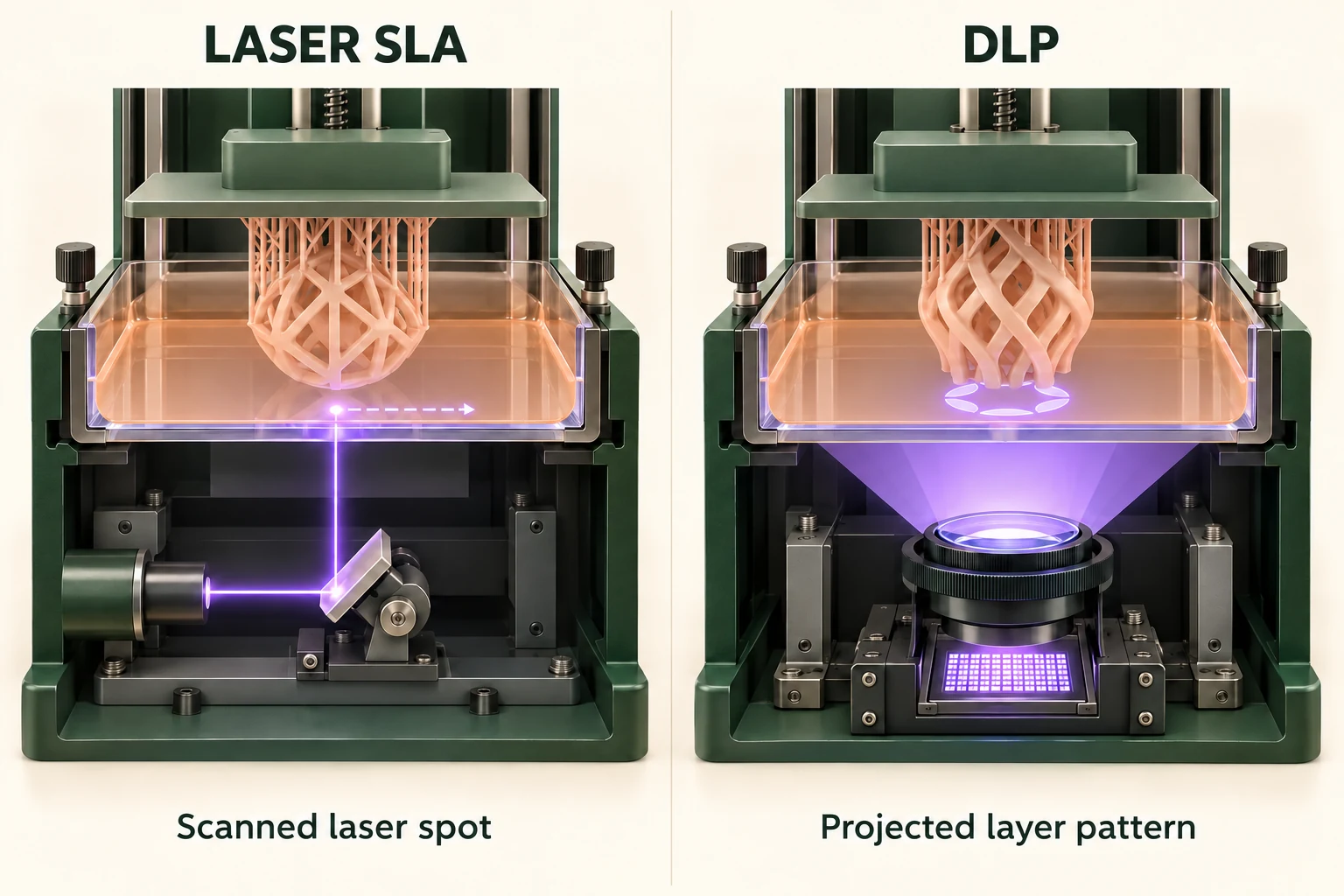
Laser SLA traces a layer with a laser; DLP projects a layer pattern. Both can be candidates for detailed resin parts. Choose using the available material, finished sample and complete production workflow. A label alone cannot promise better accuracy, strength or cost.
What SLA means in this comparison
Here, SLA means laser-based stereolithography. Some manufacturers use SLA as a broader name for resin printing, including projected or masked systems. Ask which exposure method the specific machine uses. 3D Systems describes laser SLA; Stratasys distinguishes laser SLA and P3 DLP. Both are vat photopolymerization processes.
Laser SLA vs DLP comparison
| What to compare | Laser SLA | DLP |
|---|---|---|
| Exposure system | A laser scans the layer | A projected image exposes a layer pattern |
| Pattern generation | A controlled laser path | A digital micromirror device and optics |
| Batch question | Ask how added scanned geometry affects time | Ask how a fuller layer affects the complete cycle |
| Detail specification | Examine laser positioning and finished features | Examine projected pixels and finished features |
| Material choice | Verify the printer/resin combination | Verify the printer/resin combination |
| Finishing | Use the prescribed cleaning and cure process | Use the prescribed cleaning and cure process |
| Cost comparison | Quote the finished part or batch | Quote the same finished part or batch |
| Proof of suitability | A measured sample for your application | A measured sample for your application |
DLP uses a digital micromirror device to create patterned exposure, as Texas Instruments documents. Whole-layer exposure is a useful distinction from scanning; it does not make every DLP machine faster than every laser system for every job.
Match the process to a useful test
- For a smooth presentation prototype, give each supplier the same file and identify the surfaces that will be seen. Compare delivered finish rather than the process name.
- For a batch of small repeated parts, ask for one-part and full-batch times. Include support preparation, washing, curing and inspection in both quotes.
- For a casting pattern or a functional prototype, first identify a material intended for that use. Then compare the machines and finishing procedures that support it.
These are selection exercises. Stratasys’ resin guide lists distinct material and application options; availability on one system does not establish compatibility with another.
Do not confuse resolution with accuracy
A nominal pixel or spot specification does not prove that a hole, pin or thin wall will print at its intended size. In a TI DLP reference-design test, usable printed features were assessed separately from theoretical resolution. That specific result is not a limit for modern DLP printers; the useful lesson is to measure the feature you need.
For your comparison, include a hole, a matching pin, small lettering and an outside dimension in a test coupon. Specify acceptable measurements before ordering. Ask for measurements after the required cleaning and cure, and keep the same acceptance criteria for both processes.
Is DLP always more accurate than laser SLA?
No universal winner follows from the light source. Request a sample containing your critical geometry. Record the machine, resin, orientation and finishing procedure so you can compare the result and reproduce an acceptable outcome.
Does DLP make stronger parts?
Do not treat a projector as a material property. Ask for the resin’s technical data and the required processing conditions. If the part must bend, resist impact or survive heat, make that requirement explicit and test a relevant sample.
Which costs less for a batch?
Get comparable quotes at your actual quantities. Ask whether support removal, finishing, inspection and rejected parts are included. If buying equipment, compare the full installation and service plan rather than dividing printer price by a hopeful order forecast.
Do both need resin handling and post-processing?
Yes: plan for the specific resin workflow, not just printing. 3D Systems’ SLA overview includes cleaning and UV curing. Follow the selected resin and cleaner instructions, including their safety data sheets; Formlabs’ washing guidance also explains that washing-fluid compatibility and waste handling must be checked.
Related comparisons and next steps
Compare FDM vs RESIN, DLP vs LCD, FDM vs SLS, SLA vs SLS, SLS vs MJF. Use the printer buying guide to turn the comparison into a shortlist.
Already have a project? Use the print cost calculator for your assumptions or compare buying with outsourcing before investing.
Sources & further reading
We use AI to help prepare our guides. Check the sources and follow the instructions for your specific printer and materials.