Quick answer
FDM versus SLS is a choice between extruded filament and laser-fused polymer powder. Start by comparing your material, geometry and required finish. A simple fit-check model and a small enclosure with inaccessible internal features can lead to different choices. The process name alone does not identify the best-value finished part.
What do FDM and SLS mean?
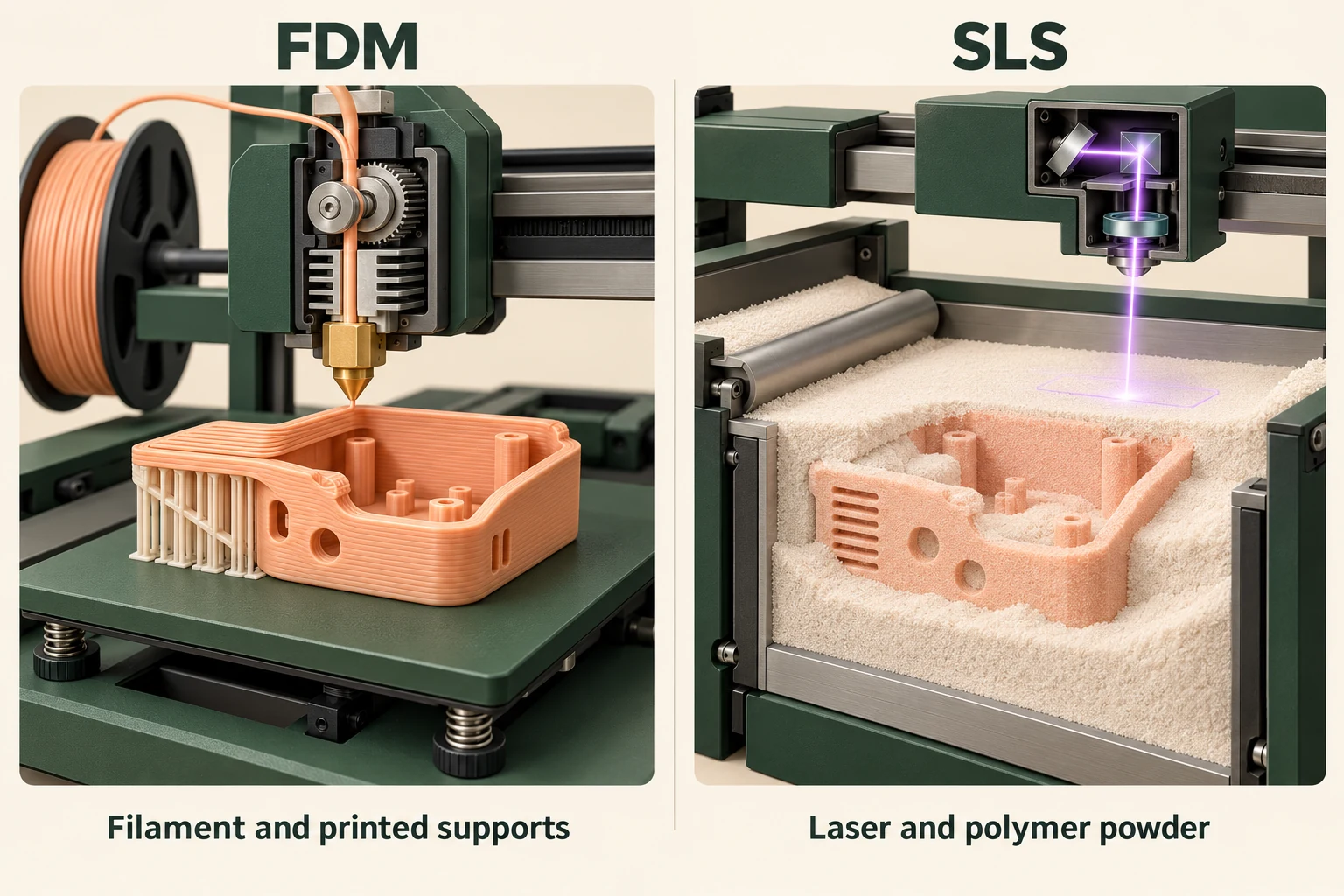
Fused deposition modelling (FDM) builds layers by extruding heated thermoplastic. Selective laser sintering (SLS) uses a laser to fuse selected areas of polymer powder. The surrounding unfused powder supports the SLS part during printing. See the Stratasys FDM guide and EOS SLS explanation.
FDM vs SLS at a glance
| What to compare | FDM | SLS |
|---|---|---|
| Feedstock | Thermoplastic filament. | Polymer powder; specify the exact grade. |
| How a layer forms | Material is extruded along toolpaths. | A laser fuses selected powder regions. |
| Supports | May need printed supports. | Surrounding powder supports the geometry. |
| Typical unfinished texture | Visible extrusion and layer texture. | Grainy powder-bed texture. |
| Cleanup to quote | Support removal where needed. | Unpacking and powder removal. |
| Geometry review | Check orientation and access to supports. | Check access for clearing trapped powder. |
| Cost comparison | Quote the required material and finish. | Quote the same quantity and acceptance criteria. |
These are workflow differences, not quality scores. FDM supports can be breakaway or soluble on compatible systems; see Stratasys support options. For typical texture and cleanup, see Formlabs’ process comparison. Hollow SLS designs need powder-removal access, described in the SLS design guide.
Choose using a real part
For a desk organiser, first ask whether the shape fits, the compartments work and the visible layers are acceptable. A basic FDM sample may answer those questions. Do not pay for a different process merely because its name sounds more industrial. Keep the acceptance checklist attached to the drawing.
For a compact housing with internal clips or channels, ask each supplier how the inside will be printed and cleaned. SLS may remove a support-access problem, but an enclosed cavity still needs a way to empty its powder. Request a sample that includes the hardest feature instead of approving only the outside appearance.
Compare strength, cost and speed fairly
Write down the load direction, expected temperature and how often the part will flex. Ask for the proposed material’s data sheet and a test sample. A nylon label is not enough to compare different formulations, print settings or finished geometries. Treat “stronger” as an unanswered question until you identify the property being compared.
For cost, request the same quantity, finish and dimensional checks. Include setup, cleanup, failed attempts and delivery where applicable. For speed, ask when inspected parts will arrive, not only how long the printer runs. These quote questions are a purchasing checklist, not a claim that either technology always wins.
Frequently asked questions
Is SLS always stronger than FDM?
No universal winner follows from the process label. Compare the named material, part orientation and the load your design must withstand. Test a representative part before relying on a comparison of isolated strength numbers.
Is FDM always cheaper?
Ask for matched quotes. A low machine or material price does not establish the final price after supports, finishing and inspection. Compare the total for usable parts, including the finish you actually need.
Does SLS need supports?
The surrounding powder supports polymer SLS parts, so attached supports are generally unnecessary. Powder still needs removing after printing. That distinction is explained by EOS; it does not mean every cavity will be easy to clean.
Your next step
Pick one part and mark its three critical features. Send the same file and checklist for both quotes, then compare a sample against those requirements. For fine visual detail, also read SLA vs SLS.
Sources & further reading
We use AI to help prepare our guides. Check the sources and follow the instructions for your specific printer and materials.