Quick answer
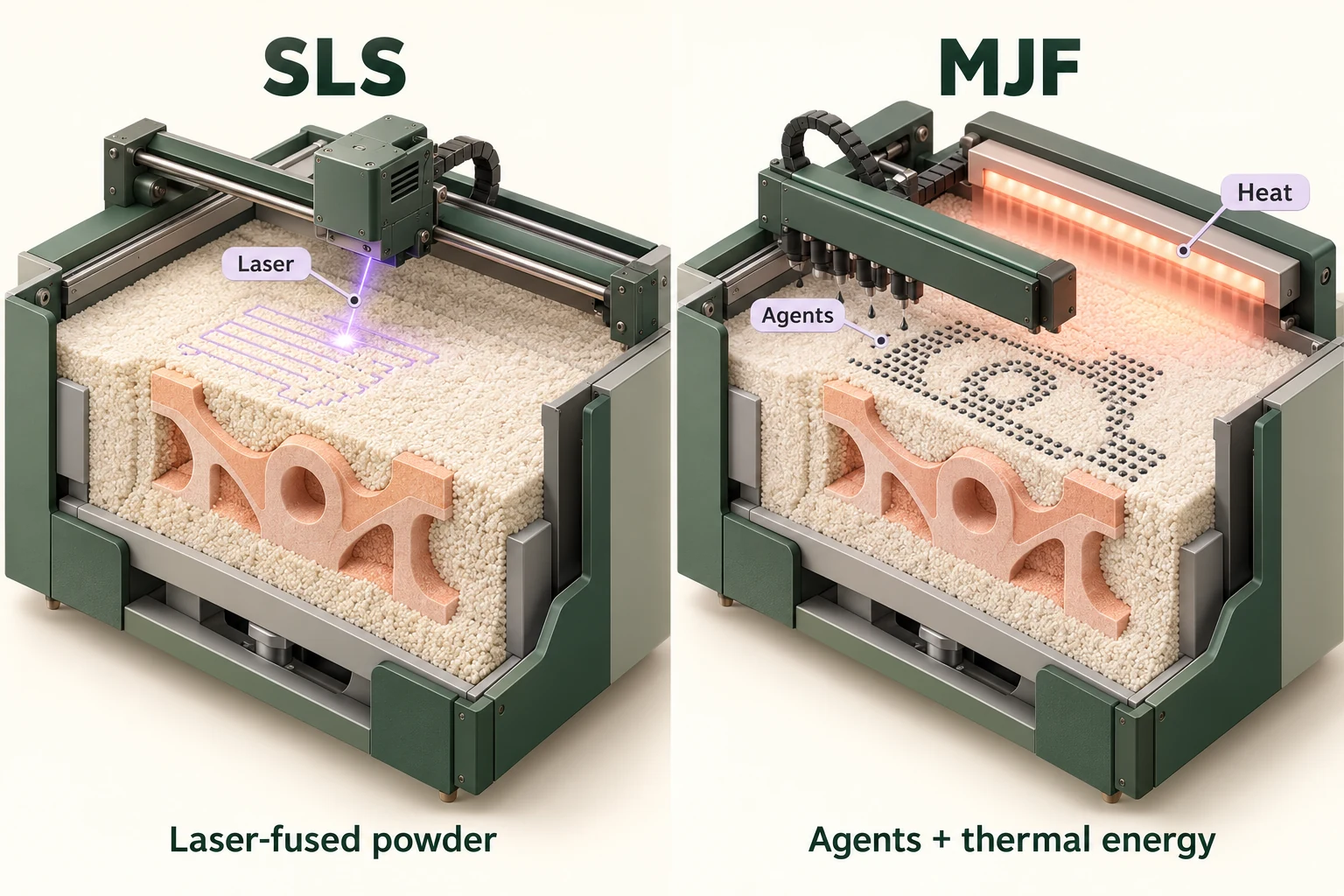
SLS and MJF are different powder-bed processes, often considered for nylon parts. SLS uses a laser; HP Multi Jet Fusion uses selectively deposited agents and heat. Compare the offered material grade, finished sample and production quote. Neither the acronym nor a generic “nylon” label guarantees the stronger, cheaper or faster part.
How SLS and MJF work
In SLS, a laser fuses selected regions of a powder layer. In MJF, fusing and detailing agents control which regions fuse when heat is applied. HP describes this area-based approach in its MJF vs SLS explanation; EOS explains the SLS powder-bed process.
SLS vs MJF at a glance
| What to compare | SLS | MJF |
|---|---|---|
| How material is fused | A laser scans selected regions. | Agents and heat define fused regions. |
| Process family | Polymer powder-bed fusion. | Polymer powder-bed fusion. |
| Material selection | Specify the compatible powder grade. | Specify the compatible HP-system material. |
| Hollow parts | Require access to remove loose powder. | Require access to remove loose powder. |
| Finish comparison | Request the actual supplied finish. | Request the actual supplied finish. |
| Mechanical comparison | Use grade-specific data and samples. | Use grade-specific data and samples. |
| Price and lead time | Quote the same geometry and quantity. | Quote the same geometry and quantity. |
The mechanism row follows HP’s explanation. For geometry, compare the Formlabs SLS design guidance with HP’s design and printing guidelines. The design limits in those documents apply to their specified systems, not every SLS or MJF service.
Do not stop at PA12
HP lists PA12, PA11, glass-bead PA12, polypropylene and elastomer options, with compatibility depending on the system. Its range also includes PA12 White, so “MJF is always grey or black” is an unreliable rule. Check the current HP material catalogue and ask which exact grade the supplier will use.
When a quote says nylon, ask for the grade and relevant data sheet. Then ask whether the sample is in the same material and finish as the proposed order. Comparing a filled formulation with an unfilled formulation is not a clean comparison of printing processes. Keep those differences visible in your quote notes.
Use the same part to compare suppliers
For a small electronics housing, identify the clip that must flex, the screw location that must hold and the surface a customer will see. Order a sample containing those features. Try the intended assembly, record the result and photograph the finish. This gives you evidence that is relevant to the part instead of relying on an unrelated demonstration sample.
For a repeat batch, ask for prices at the quantities you actually expect to order. State whether mixed parts can share the order, whether individual dimensions need checking, and how the finished pieces should be packed. Compare the cost of accepted parts, rather than assuming a densely packed machine always makes your particular order cheaper.
Strength and speed are not one-number comparisons
Translate “strong” into the property you need: stiffness, impact resistance, repeated bending or behaviour at operating temperature. Ask about material condition, orientation and the test method behind the number. A test coupon helps compare materials; your assembled part still needs its own acceptance check.
For timing, ask for the date inspected parts are ready to dispatch. Include the supplier’s queue and required cooling, cleaning and finishing. Print-engine speed is only one part of delivery. Request the same finish and delivery conditions before treating one process as faster for your job.
Frequently asked questions
Is MJF a type of SLS?
No. Both belong to powder-bed fusion, but their fusion mechanisms differ. MJF uses agents and heat; SLS uses a laser. HP’s comparison explains why similar-looking powder-bed parts can come from different processes.
Are PA12 parts identical across SLS and MJF?
Do not assume they are. Request the actual material formulation, processing route, finishing and relevant property data. Compare samples against the same acceptance criteria rather than treating the polymer family name as a complete specification.
Which is cheaper for a small batch?
Obtain matched quotes for your files and quantity. Include finishing, inspection, delivery and any minimum charge. This is a job-specific purchasing decision; a process-wide price ranking would hide the factors that determine what you pay.
Your next step
Prepare a short comparison brief: file, quantity, named material, critical dimensions, finish and required delivery date. If you are still deciding whether powder printing is necessary, read FDM vs SLS.
Sources & further reading
We use AI to help prepare our guides. Check the sources and follow the instructions for your specific printer and materials.