Quick answer
SLA and SLS can both produce useful prototypes and working parts. SLA uses liquid resin cured with light; SLS fuses polymer powder with a laser. Start with the surface you need and the material behaviour your application requires. “Resin for looks, powder for function” is too broad to be a dependable selection rule.
What is different about the processes?
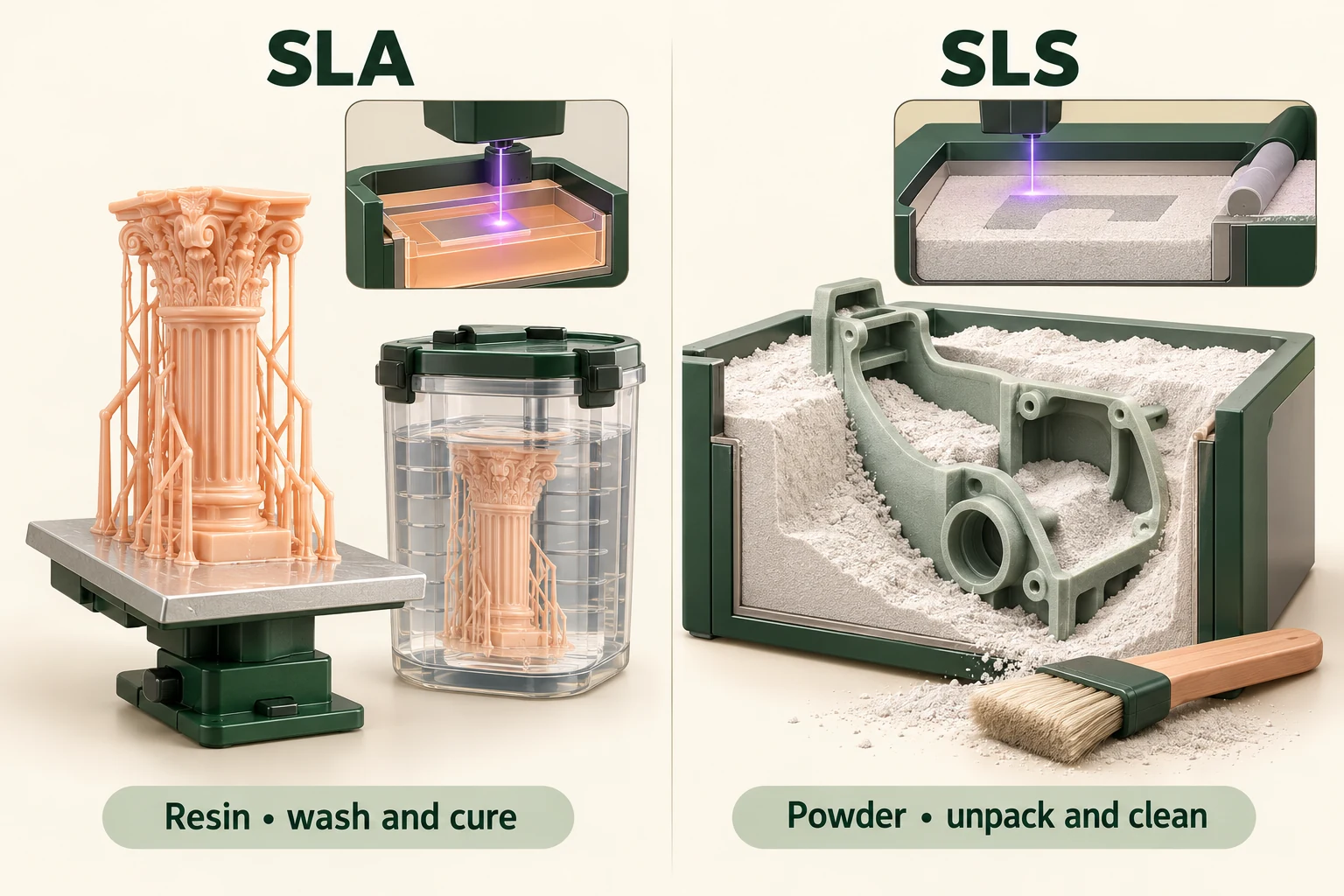
Stereolithography (SLA) is resin printing; selective laser sintering (SLS) is powder-bed printing. SLA commonly produces smooth, finely detailed surfaces, while unfinished SLS surfaces are usually grainier. Functional resins and several SLS powder families exist. The Formlabs SLA/SLS comparison documents these distinctions without making every material interchangeable.
SLA vs SLS at a glance
| What to compare | SLA | SLS |
|---|---|---|
| Starting material | Liquid photopolymer resin. | Polymer powder. |
| Layer formation | Light cures selected resin regions. | A laser fuses selected powder regions. |
| Typical surface | Smooth, with fine visible detail. | Textured before optional finishing. |
| Supports | Often uses attached supports. | The powder bed supports the part. |
| Basic cleanup | Wash; follow the resin’s curing procedure. | Remove loose powder and clean the part. |
| Internal features | Plan access for draining and cleaning. | Plan access for powder removal. |
| Material specification | Name the resin and required processing. | Name the powder grade and finish. |
For the support workflow, see Formlabs’ SLA support-removal instructions. For washing, material-dependent post-curing and SLS cleaning, see its process comparison. These steps belong in the quote, even when the supplier performs them for you. For enclosed parts, Formlabs’ hollowing guidance explains drainage access for resin and powder.
Two practical decisions
Imagine a presentation model with tiny lettering, a smooth curved face and no demanding mechanical duty. Ask for an SLA sample that contains the actual lettering and curve. Judge it under the lighting and viewing distance you will use. A printer resolution number cannot substitute for checking that particular feature.
Now consider a housing that will be opened repeatedly. Ask for candidate materials and test its clips, screw locations and wall sections. SLS nylon may be worth evaluating, but do not exclude an engineering resin without comparing its documented properties. A short test plan makes the decision specific: assembly fit, repeated opening, and the appearance after handling.
The hidden geometry question
SLS can form complex shapes without attached supports, but trapped powder must still be accessible. Formlabs’ SLS design guide calls for escape holes in enclosed or deep cavities and warns about changes in wall thickness. Use the actual supplier’s design rules; its machine-specific dimensions are not universal SLS tolerances.
Cost, strength and speed need context
Ask for a finished-part price that includes your required cleanup, surface treatment and inspection. Separate the first sample from a repeat batch. A cheap first piece and an economical repeat order are different questions, and neither can be settled by comparing raw resin and powder prices alone.
Compare delivery of usable parts, including any washing, curing, cooling, cleaning and finishing required by the chosen workflow. For strength, specify impact, stiffness, heat exposure or repeated flexing rather than a single “strong” label. Ask which property the material data describes and confirm important behaviour with the finished sample.
Frequently asked questions
Is SLA only for decorative models?
No. Manufacturers offer functional resins as well as visual-model materials. The Formlabs comparison lists functional prototyping and tooling applications. Choose a particular resin and validated processing route, rather than assuming every resin has the same behaviour.
Will SLS give me a smooth finish?
Ask to see the exact finish being quoted. An untreated powder texture and a smoothed, coated or polished sample are different deliverables. Record the finish on the order so price comparisons remain meaningful.
Which is more accurate?
Request the supplier’s capability for your specific features and their inspection method. Mark mating surfaces, holes and critical dimensions. Avoid turning a layer-height or pixel specification into a blanket dimensional-accuracy promise.
Your next step
Choose one representative feature, one appearance check and one functional check. Compare samples against them. If powder-bed nylon is the direction you want to explore, continue with SLS vs MJF.
Sources & further reading
We use AI to help prepare our guides. Check the sources and follow the instructions for your specific printer and materials.