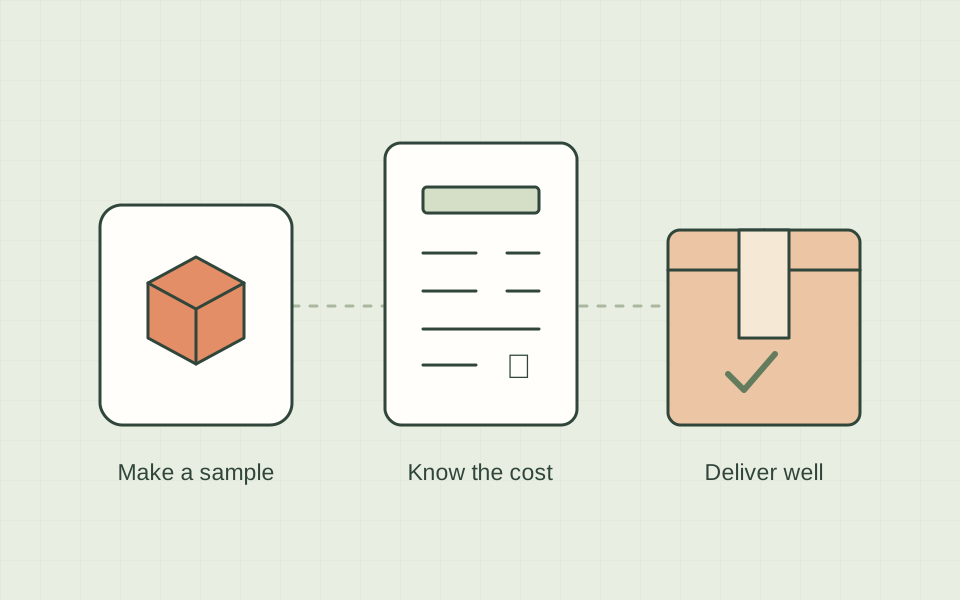
Price a 3D printing job by listing the costs of delivering the finished order, then adding enough contribution to make the work worthwhile. Filament weight alone does not capture design work, preparation, finishing or failed attempts. The example below is deliberately hypothetical: it teaches the arithmetic and is not a market rate, current supplier price or 3dkavi quotation.
Write down what the quote includes
Begin with the quantity, dimensions, material, finish and approved design version. Separate new design work from printing an existing usable file. State how many revisions are included and whether packing or delivery is included. Without a clear scope, two quotes can look different even when they cover different amounts of work.
Work through one example
Assume a fictional 1 kg spool costs ₹2,000 and the sliced job uses 50 g including supports. The material calculation is ₹2,000 ÷ 1,000 g × 50 g = ₹100. These chosen round numbers are only for practice. Replace them with your actual purchase cost and relevant material usage.
| Cost item | Hypothetical calculation | Amount |
|---|---|---|
| Material | 50 g × ₹2 per gram | ₹100 |
| Hands-on work | 30 minutes × ₹400 per hour | ₹200 |
| Machine and upkeep allowance | 2 hours × ₹40 per hour | ₹80 |
| Electricity | 0.20 kWh × ₹20 per kWh | ₹4 |
| Packaging | One job allowance | ₹40 |
| Reprint allowance | Planning amount for this example | ₹36 |
| Total included cost | 100 + 200 + 80 + 4 + 40 + 36 | ₹460 |
The energy use, hourly rates and allowances above are assumptions. Measure or obtain your own inputs. Avoid counting the same expense twice: if your machine rate already includes electricity, do not add it again. A reprint allowance should eventually come from your recorded failures, not a percentage copied without checking.
Markup and margin are different
If you add a 30% markup to the example cost, the calculation is ₹460 × 1.30 = ₹598. The difference is ₹138. That difference is about 23.1% of the selling price, not a 30% margin. If you instead want the difference to be 30% of the selling price, calculate ₹460 ÷ 0.70 = ₹657.14. These are two different pricing choices.
Count human time honestly
Include time spent checking files, discussing changes, preparing the job, removing supports, inspecting and packing. Machine time and human working time are different. A two-hour print does not necessarily require two hours of hands-on work, while a short print can still take substantial design time. Record both so you can explain the price and improve the process.
Check the quote after delivery
Compare the estimated material, hours and allowances with what actually happened. If a sample needed redesigning or a failed print consumed extra material, record it against the order. Review several jobs before changing your standard rates. A low quote that repeatedly misses preparation work is information about the costing process, not proof that printing cannot be viable.
Use this worksheet to build an informed price, then compare it with the value and requirements of the customer’s job. Confirm current applicable tax treatment separately when preparing an actual invoice. For the wider workflow, read starting a small 3D printing business.
Sources & further reading
We use AI to help prepare our guides. Check the sources and follow the instructions for your specific printer and materials.